
One shared context for every incident
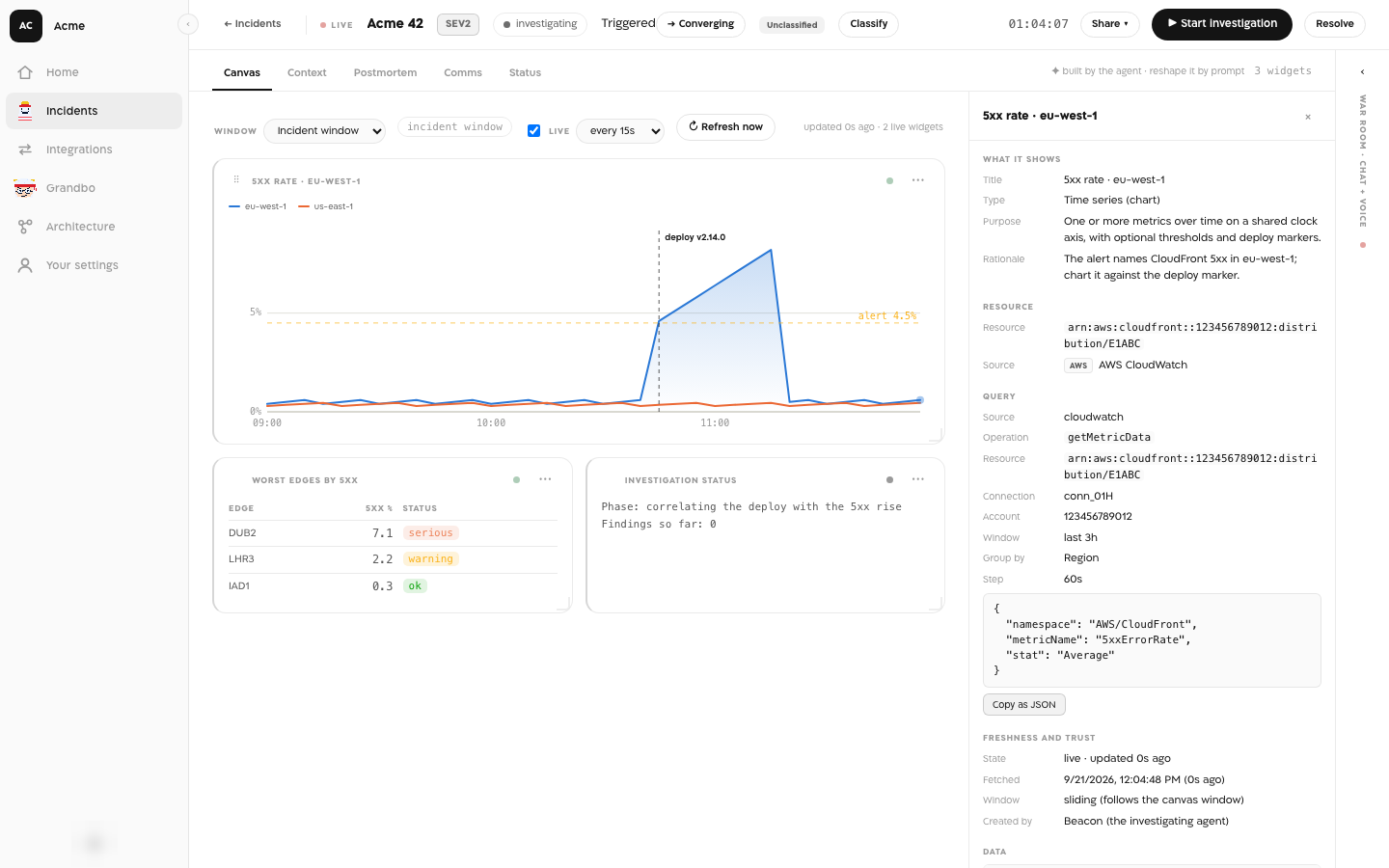
Incidents fragment across Slack, Teams, Zoom, DMs and every responder's favorite harness. Landfall is the one war room where the whole crew works from the same live context. People, Beacon (the room's AI agent) and each responder's harness work from one event-sourced timeline. A finding or hypothesis a harness shares waits there until the room admits it.

The problem
Incident response used to fragment across people. Now it fragments across people and their agents. When something breaks, every responder reaches for their own favorite harness (the coding agent you already use: Claude Code, Codex CLI, VS Code, Cursor, Claude Desktop, Windsurf) and each one investigates in its own private context window. What each person (and each agent) learns gets shared the only way it can be: pasted into Slack as a Markdown dump, dropped into Teams as raw text, screenshotted, exported as HTML, forwarded in a DM, talked through on a Zoom bridge nobody writes down.
The result is that the incident's real state lives nowhere. Two engineers chase the same hypothesis without knowing it. An agent reasons from a stale graph someone pasted twenty minutes ago. A handoff loses everything that wasn't written down. The postmortem is archaeology across four chat platforms.
In the agent era, context sharing is the coordination problem. An investigation moves as fast as verified context reaches everyone who needs it, human or agent.
Who it is for
Landfall is for the people who get paged. On-call engineers, NOC and SOC teams, plus the service owners, managers and stakeholders who get pulled into the incident. An outage or a breach, the room is the same.
Your AI SRE hands responders the first direction. Landfall is complementary to it. It is the room where the humans resolve what comes next, the phase where several people and their favorite harnesses have to work from one picture. Beacon, the room's AI agent, narrates and investigates in the open. A finding or hypothesis a responder's harness shares is staged until the room admits it. Landfall never approves or runs a change. Agents suggest a fix with blast radius and undo; a human applies it in their own tools and records it in the room. Read How a war room works for the whole picture.
How Landfall solves it
- One live context. Every incident opens a war room with an event-sourced timeline as the single source of truth. Findings, charts, logs and decisions land there once, in realtime, for everyone. What goes out to Slack or Teams is a copy of that record.
- Your agents join the crew. The open-source landfall CLI connects your favorite harness to the room over MCP. Its findings publish to the shared timeline, and it pulls what everyone else discovered between tasks.
- A harness's findings wait for the room. A finding or hypothesis a responder's harness shares through the landfall CLI is staged behind the admission gate, and other agents receive it only once the room admits it. People vote and flag; on a default install a harness logs findings and casts no vote. In an incident room a plain observation is admitted automatically once Landfall has re-checked it against the source, while a cause, a correlation or a directive needs a person. Posting a finding counts as its author's vote, which never admits it alone, and a human override always wins. Context the room later finds wrong is hidden from every agent, with the reason on the record, and never deleted.
- Humans stay in command. Agents suggest remediations with blast radius and undo; a human applies them outside Landfall. Landfall never approves or runs a change.
- The postmortem is already drafted. The timeline is the record, and the Postmortem tab folds it into a draft with no model writing it. The root cause comes only from findings the room admitted.